On Wikipedia, the standard is verifiability, not truth. The site requires information to be supported by reliable published sources, even when someone with firsthand knowledge says those sources are wrong.
A common thing I hear from people who want to correct information on Wikipedia is, “but it’s the truth.”
It may be. Wikipedia does care about accuracy, but its editors cannot settle a dispute by taking someone’s word for it. They need evidence they can check.
What “verifiability, not truth” means
Wikipedia’s verifiability policy once said, “The threshold for inclusion in Wikipedia is verifiability, not truth.” That sentence was replaced in 2012. The phrase “verifiability, not truth” remains in a policy footnote and an explanatory essay, which offers editors’ advice rather than setting the rules.
The current policy bases article content on published information rather than editors’ beliefs or experiences. Wikipedia’s volunteers can compare a statement with a published source; they usually cannot independently confirm someone’s private account of an event.
Who has to supply the source
The editor who adds or restores disputed material must supply a reliable source that directly supports it. Quotations and material challenged or likely to be challenged need an inline citation.
You do not have to prove a claim false to question its sourcing. If it lacks adequate support, you can ask for a source or its removal. If you propose replacement wording, supply reliable published evidence for that wording.
A citation does not make an error permanent. Reliable sources can make mistakes, and editors can correct an error when there is evidence supporting the change.
Why isn’t firsthand knowledge enough?
Firsthand knowledge alone is not a published source other editors can consult. The same applies to a private email or letter.
Wikipedia’s no original research policy prevents editors from using articles to publish information based solely on their own experience. It also bars combining sourced facts into a conclusion none of the sources makes.
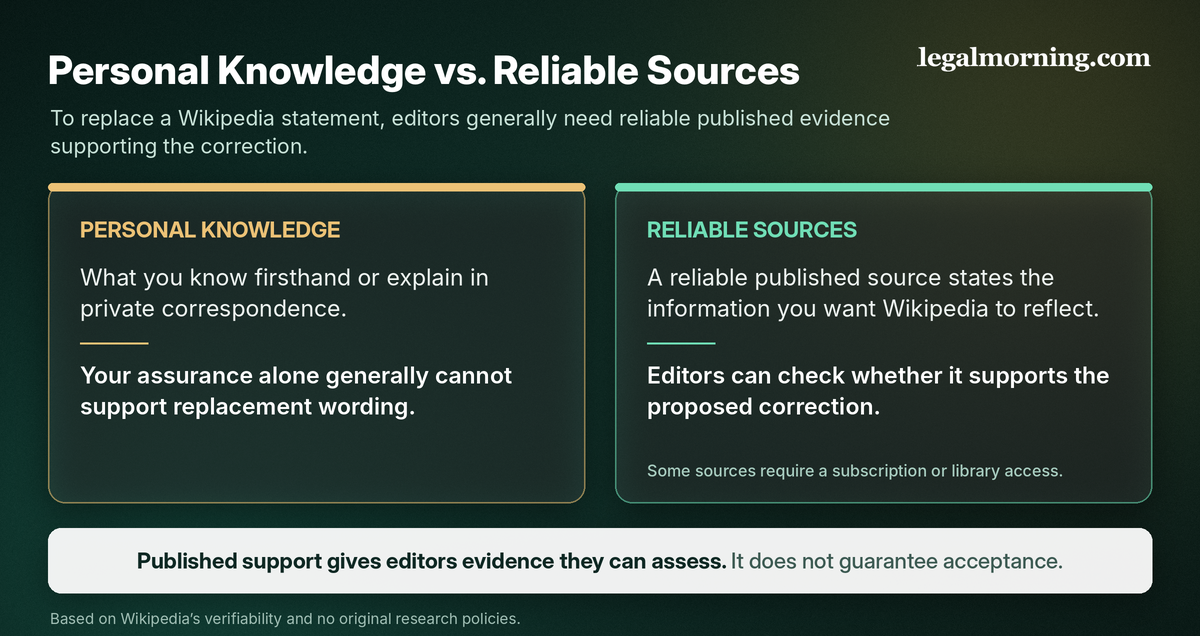
For a proposed correction, published evidence gives editors a source they can consult. Personal assurance alone generally cannot support replacement wording.
What evidence can support a correction
Wikipedia articles generally rely on reliable secondary sources: publications that analyze or interpret original material. “Secondary” does not mean “independent.” A source can analyze a subject while still being connected to it.
Appropriate primary sources can support straightforward facts that require no specialized interpretation. Editors cannot use them to draw their own conclusions.
A subject’s website or press release may support basic information about the subject, within limits. It cannot support unduly self-serving or exceptional claims, or claims about third parties, and the article should not rely mainly on such sources. An official website does not automatically override reliable reporting.
Sourcing rules are stricter for living people. Court records and similar public documents, for example, cannot be used alone to support claims about someone.
The source must support what Wikipedia actually says. Reliability depends on the source and the claim being made, as the reliable sources guideline explains.
Sourcing is also only one requirement. Editors consider whether information belongs in the article and how much attention it deserves. Verifiability does not guarantee inclusion.
How to fix information that is wrong
Poorly sourced claims about living people need prompt attention
Wikipedia requires immediate removal of contentious material about living people that is unsourced or poorly sourced. This includes disputed or potentially harmful claims, whether positive, negative, or neutral. The rule applies across Wikipedia, not only in biographies. Do not wait for a publisher’s correction.
The removal rule concerns inadequate sourcing; it does not justify deleting well-sourced information simply because it is unfavorable.
People connected to the subject may remove an unambiguous biography-policy violation. A personal objection alone does not establish one. If the issue is unclear or contested, seek help on the article’s talk page, its attached discussion page, or the biographies of living persons noticeboard.
Check the statement and request a correction
1. Read the wording and its citation. Identify the exact sentence you dispute and check whether the cited source supports it. If adequate sourcing is missing, explain that problem when requesting a source or removal.
2. Identify where the error occurred. When a statement has a citation, check whether Wikipedia misrepresents the source or accurately repeats an error in it. These are different problems, with different next steps.
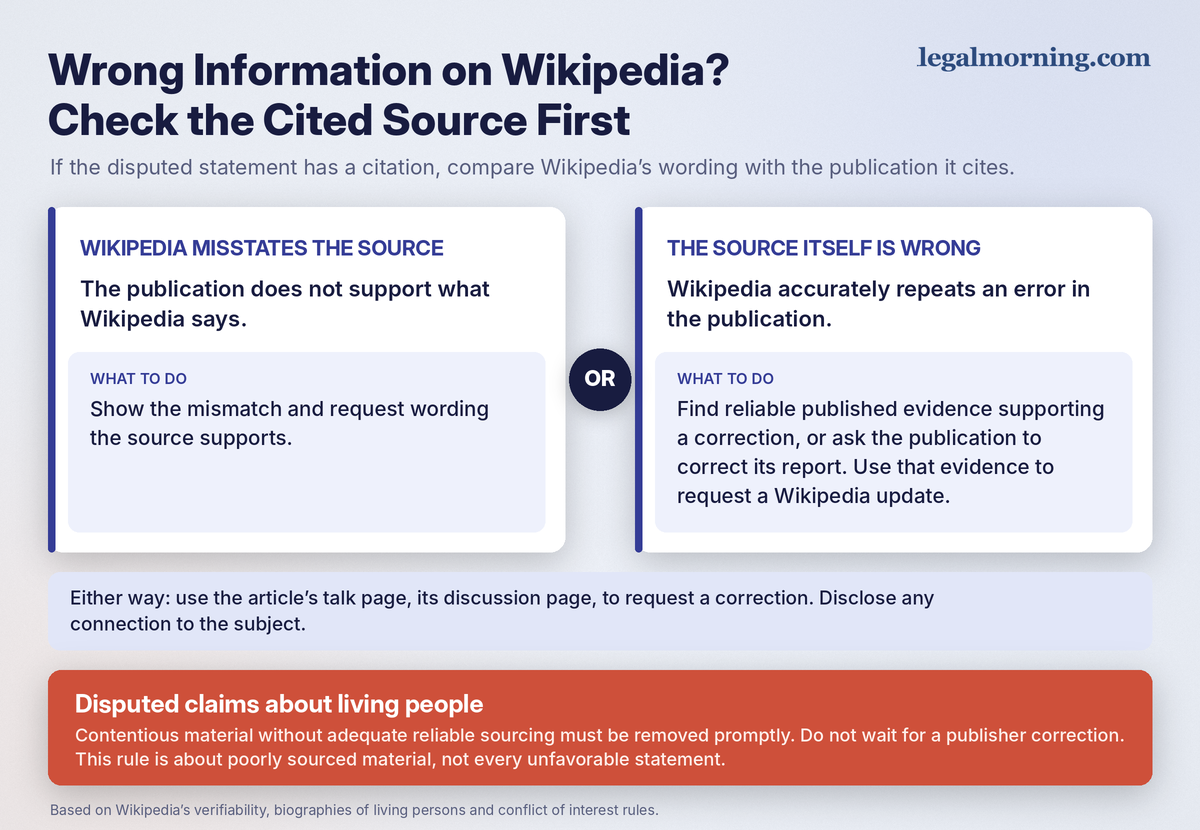
Compare the Wikipedia statement with its cited publication to determine which correction route fits the problem.
3. Gather evidence for the correction. Find reliable published sources supporting the wording you propose. If a news outlet made the mistake, ask it to publish a correction. That correction can support a Wikipedia update, but someone must still request or make the change.
You do not need to wait for the publisher if other reliable sources already support a correction. When sources disagree, editors weigh their quality and the prominence of each view in reliable coverage. They do not give every position equal space.
4. Disclose your connection and submit the request. If you are the subject or represent the subject, disclose that relationship. Wikipedia’s conflict of interest guideline strongly discourages directly editing affected articles; propose the change on the talk page instead.
The Edit Request Wizard can guide you through submitting a request.
Paid editors must disclose each employer, client, intended beneficiary, and affiliation connected to compensated contributions, under the Wikimedia Foundation’s Terms of Use.
Wikipedia’s paid-contribution disclosure page explains how to make those disclosures.
Include these four things in the request:
- The exact wording you dispute.
- The replacement wording you propose, or a clear request for removal.
- Links to reliable supporting sources, where applicable.
- A brief explanation of the problem.
Where to raise serious concerns
For legal or other serious concerns, Wikipedia’s biography policy directs subjects to the volunteer response team at info-en-q@wikimedia.org. Include the article link and explain the problem.
Oversight is a separate, private route for evaluating whether sensitive material qualifies for removal from public view, including page history. Examples include non-public personal information and clearly or likely libelous content. Use the official contact instructions and do not repost the sensitive material publicly.
Before you request a change
Wikipedia’s standard is verifiability, not truth, so start with the disputed statement and its source. Explain any sourcing problem, provide evidence for replacement wording, and disclose your connection when requesting a correction.
Need help assessing the sources? Contact Legalmorning for a free evaluation of the disputed information and your correction options.