Simple English Wikipedia is a separate edition of Wikipedia written in simpler English, with its own articles and community of editors. It serves English learners, students, children, adults with learning difficulties, and anyone who wants a plain explanation of an unfamiliar topic.
For individuals and organizations, Simple English Wikipedia can help reach readers who find the English edition difficult. If you qualify for an article, a neutral, well-sourced entry can explain who you are and what you do in accessible language. Researchers have also used its content to train language models.
What Simple English Wikipedia Is
Simple English Wikipedia lives at simple.wikipedia.org. Like English Wikipedia, it is hosted by the Wikimedia Foundation and written by volunteers. Its About page describes an encyclopedia for English learners and readers with different needs, not just children.
Its own articles, community and rules
Each Simple English article is a separate page with its own text, history and editors.
The site also has its own policies and guidelines. Where it has no local rule, a local guideline says to look at English Wikipedia’s rule for guidance. Even then, English Wikipedia policies count only as guidelines here, and local rules come first.
The smaller community uses different tools and review processes, as the editing steps below explain.
Changes don’t carry over automatically
Language links let readers switch between editions of the same subject. They do not synchronize the text.
Changing an English Wikipedia article does not by itself update the Simple English version. A volunteer has to make that change on Simple English Wikipedia, in simple language.
According to the About page, most Simple English articles begin as adaptations of articles on other Wikipedias. Volunteers maintain them separately afterward.
Simple language for complex ideas
The local writing guide puts it this way: the language is simple, but the ideas do not have to be.
Writers should use common words, simple sentences and the active voice. Explain necessary technical terms or link to a page that does.
Explaining an unfamiliar idea in plain words can take more words than the original. A simpler article is not always a shorter one.
- Editors of other language editions can also use these articles as a starting point for translation, as the About page explains.
How It Differs From English Wikipedia
The easiest way to see the difference is to read the same subject in both editions.
These examples come from the opening of the Black hole article on English Wikipedia and Simple English Wikipedia, as they read in November 2026:
| What changes | English Wikipedia | Simple English Wikipedia |
|---|---|---|
| Plainer words | “an astronomical body” | “a place in space” |
| Technical terms | “the boundary of no escape” | “the outer edge of a black hole” |
| Background | “a mathematical curiosity” | “just an idea in mathematics” |
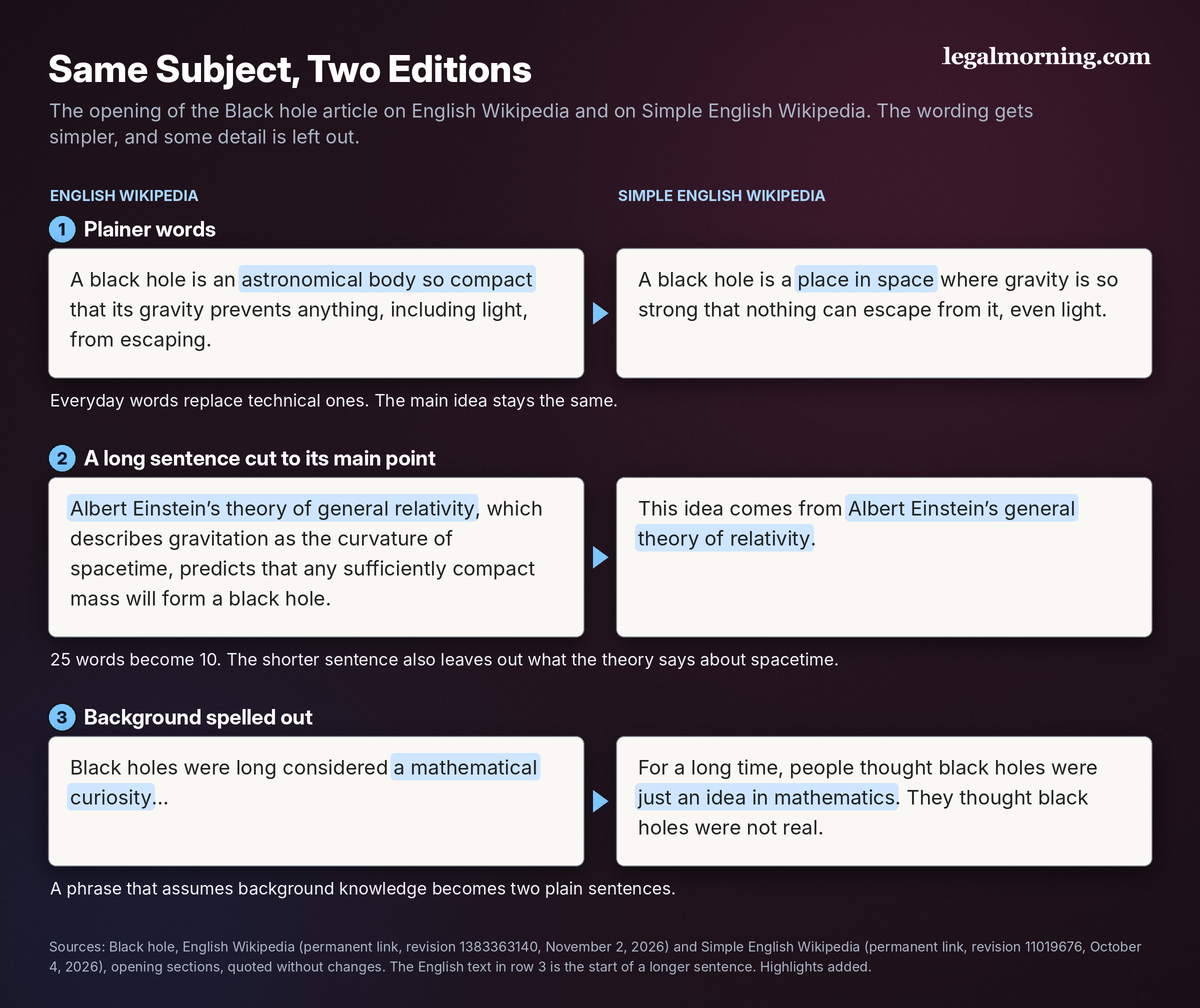
How the two editions explain black holes. The simpler version sometimes leaves out detail.
What the comparison shows
Vocabulary is the most visible change, and background is spelled out rather than assumed.
The English opening explains that general relativity describes gravity as the curvature of spacetime and predicts black holes. The Simple English opening says the idea comes from Einstein’s theory. That shorter sentence leaves out part of the explanation.
Simpler doesn’t always mean less specific. Where the English opening says the idea was first considered in the 18th century, the Simple English opening names the two scientists who first discussed it.
Quality and completeness vary
Because different volunteers maintain each edition, either article may be more current, complete or accurate. Check the cited sources when you need to rely on a claim.
How AI Researchers Use Simple English Wikipedia
Researchers have used Simple English Wikipedia to train small language models and to develop tools that simplify text.
Training teaches a model patterns from text, while evaluation tests its performance. Neither is the same as an AI search tool looking up a page while answering a question.
The studies below document research uses. They do not establish which pages commercial AI products use to answer questions.
Training small language models
The BabyLM Challenge asks researchers to train language models on roughly the amount of language a child encounters, far less than commercial models typically use.
The organizers’ 2023 findings paper says about 15% of the training data they released came from Simple English Wikipedia. Their 2025 baseline model, which participants can compare their models against, was trained on data that includes it.
At the 2025 BabyLM Workshop, Yen-Che Hsiao and Abhishek Dutta reported training small language models on Simple English Wikipedia text from the BabyLM dataset. They chose it for its compact coverage of general knowledge in basic English.
The models produced simple, coherent English but struggled to generalize beyond their training material.
Teaching computers to simplify text
A hard sentence and its simpler counterpart can provide a training example for a system that rewrites text.
A 2011 study by William Coster and David Kauchak matched about 137,000 sentence pairs from English and Simple English Wikipedia. Such pairs have been used to train and test simplification systems.
The pairs are not always useful. A 2015 paper by Wei Xu, Chris Callison-Burch and Courtney Napoles found that about half the pairs in one widely used dataset were not simplifications. That finding applies to the dataset they examined, not every pair of Wikipedia articles.
These studies do not establish whether ChatGPT, Gemini or another commercial model trained on Simple English Wikipedia. Having an article there does not guarantee an AI mention, citation or ranking.
How to Edit or Create an Article
If you are connected to a subject or paid to write about it, read the next section on conflicts of interest before you change anything.
Find the article and its editing controls
Search for the subject at simple.wikipedia.org. Try other names and spellings too.
Simple English Wikipedia uses “change” where English Wikipedia uses “edit.” Change opens the visual editor; Change source opens the page’s wiki code. Both links also appear beside section headings.
The Talk tab opens the article’s talk page, where editors discuss changes. View history shows every past version. The languages menu lists the same subject in other editions.
In the source editor shown below, describe your edit in the Change summary box. Click Show preview to check it, then Publish changes to make it live. The visual editor uses a different saving dialog.
Log in before you edit. If you aren’t logged in, the site creates a temporary account for you when you publish.
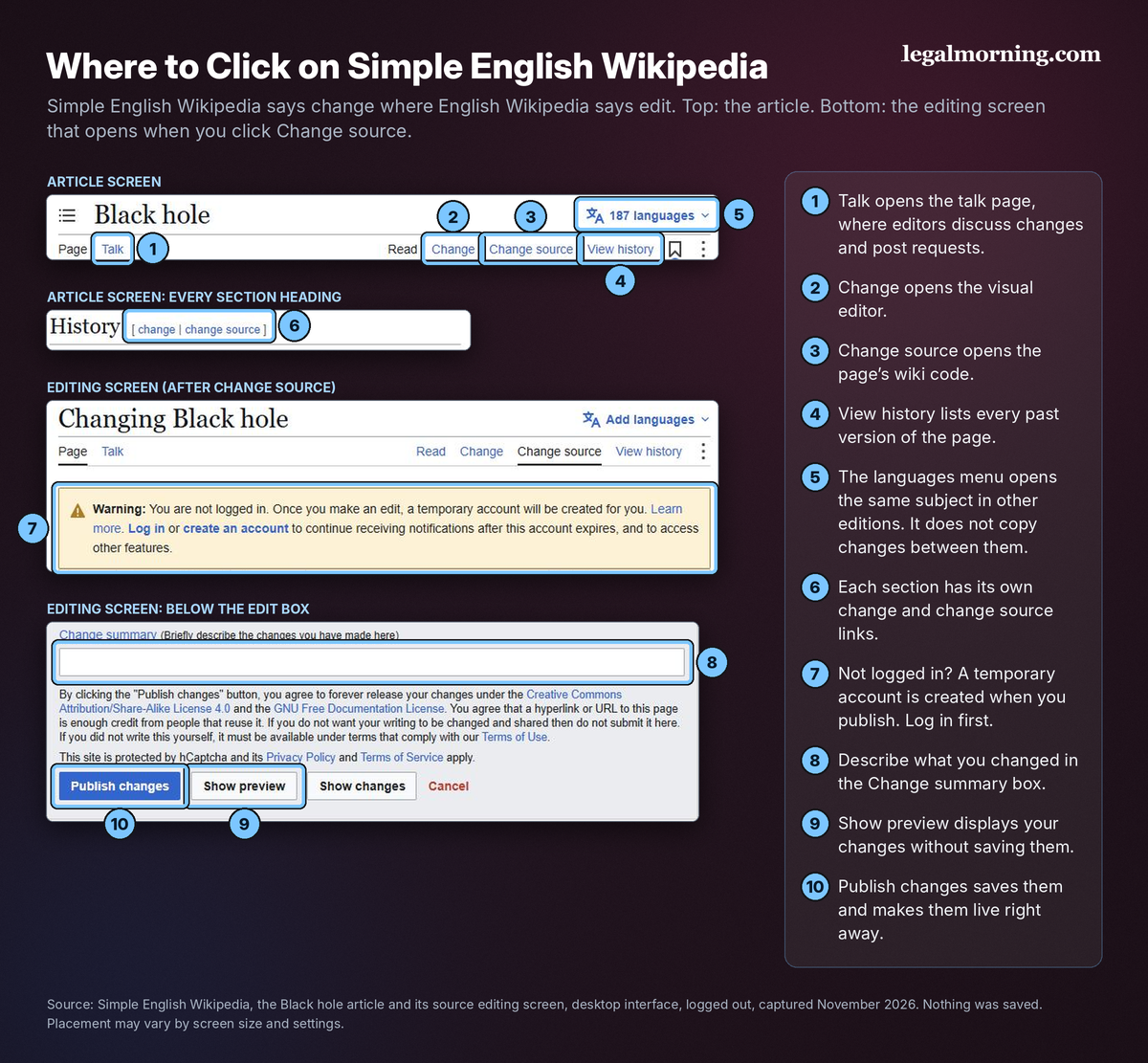
The article screen and the editing screen on Simple English Wikipedia.
Use the local Article Wizard
Search for the subject under other names and spellings before starting a page. The local Article Wizard can help you create a redirect if the article already exists under another title.
The wizard walks through six steps covering the subject, notability, sources and content. Unlike English Wikipedia, Simple English Wikipedia has no Articles for Creation review queue or separate Draft namespace.
At the last step, Ready for submission, you choose between two options:
- Create a draft page in your own user space. You need an account for this.
- Create the article directly. The wizard warns that it should already meet the notability, sourcing and content requirements, or it may be deleted.
The wizard itself recommends changing a few existing articles before you create your first one.
Working from a draft in your user space
- In the wizard’s last step, type the article name in the draft box and click Create new draft page. The draft opens at an address like User:YourUsername/Article name.
- Write the draft and click Publish changes to save it. This does not create an encyclopedia article, but your draft is public. The wizard adds a label identifying it as a draft and marking it for exclusion from search indexing.
- To come back to it, find it in your Contributions list, or bookmark the draft’s address.
- When it meets the requirements, use Move in the page menu to move it to the article title. Your account generally needs at least 10 changes and more than four days since its first change. Moving preserves the editing history.
- If Move is unavailable, ask at Simple talk for help or wait until your account qualifies. Avoid copying the text into a new page: that does not transfer the editing history, including other contributors’ work.
If you have a conflict of interest, seek agreement before publishing the draft as an article. Post a short note at Simple talk disclosing your connection and asking an uninvolved editor to review it.
Write simply without losing meaning
The writing guide gives a practical method:
- Write the way you’d speak to an ordinary person.
- Prefer words from the Basic English word lists the guide links to.
- Use short sentences, with one idea in each.
- Use the active voice. Write “The cat ate the bird,” not “The bird was eaten by the cat.”
- If a hard word or name is necessary, explain it in plain words or link to an article that explains it.
Keep the context needed to understand a claim. Removing a date or qualifier just to shorten a sentence can make it inaccurate.
Meet the same standards for neutrality and sources
Articles must be neutral and must cite reliable, published sources. The local notability guideline says a subject needs significant coverage in reliable sources that are independent of it.
The quick deletion rules let administrators delete some pages without a discussion. That includes articles about people or companies that don’t explain why the subject is notable, and obvious advertising.
Adapting material from English Wikipedia
You may adapt English Wikipedia text if you simplify it and credit its contributors. The local guideline on copying from another Wikipedia explains how:
- Copy only what you need from the English article into the edit box.
- Rewrite it in simple English before you publish. Don’t save unsimplified text and plan to fix it later.
- Fix or remove templates and images that don’t work here. Images must be hosted on Wikimedia Commons.
- Credit the source in your change summary, for example: Added information copied from the English Wikipedia article [[:en:Plant]].
Instead of the change summary credit, you can add this to the new article’s talk page. Use the Permanent link in the English article’s Tools menu for the address of the exact version you used:
{{Enwp based|url=PERMANENT LINK TO THE ENGLISH WIKIPEDIA VERSION}}
Attribution credits the volunteers whose wording you adapted. Source citations support the facts. You need both, and you should check the cited sources rather than assume the English article is correct.
Pasting an English article without simplifying it is a reason for quick deletion.
The local rules on AI writing
The local AI-generated content guideline permits AI writing only if it follows the style guide, uses simple language and cites reliable sources. Check every claim and reference before using it. Pages containing AI-generated content must carry the {{AI-notice}} template.
The notice does not protect a page from deletion. Under the local quick deletion rule, two editors can recommend a clearly AI-generated page for deletion by an uninvolved administrator. Inaccurate, promotional or overly complex content can also be removed.
Write the article yourself, from sources you have checked.
Where to ask for help
Simple talk is the main community page. It works as the help desk, the reference desk and the general discussion board. You can also ask on the talk page of the article you’re working on.
Conflicts of Interest and Paid Contributions
Simple English Wikipedia has its own conflict of interest guideline. On top of that, the Wikimedia Foundation’s Terms of Use set a disclosure rule for paid editing that applies across its projects.
What the local guideline says
The guideline defines a conflict of interest as putting outside goals ahead of building the encyclopedia. It recommends disclosure on your user page and the talk page of each affected article.
Common situations include:
- Writing about yourself: the guideline discourages it. If you believe you qualify for an article, raise the idea on a talk page and seek agreement.
- Your employer or business: the guideline strongly discourages direct editing because of the financial connection.
- Client work: the same financial concerns apply. Promotional client profiles are prohibited.
Connected editors may still make some uncontroversial changes, such as fixing spelling, removing vandalism, or making a change that other editors agreed to on the talk page.
Simpler language does not lower the standards for sources or neutrality. This is not an easier place to publish a promotional profile.
Paid editing must be disclosed
If you are paid to contribute, disclosure is required. The Foundation’s Terms of Use require you to disclose every employer, client, intended beneficiary and affiliation for any paid contribution.
That disclosure has to appear in at least one of these places:
- your user page
- the talk page that goes with the paid contribution
- the edit summary of the paid contribution
That is the minimum. The local guideline recommends disclosing on both your user page and the article’s talk page.
Some Wikimedia projects have alternative disclosure policies. Simple English Wikipedia is not on the Foundation’s list of projects with an alternative policy. Its page for article subjects also tells paid contributors to disclose their connection.
Where each disclosure goes
Your standing disclosure goes on your user page. Open it from your username at the top of any page while logged in.
For paid work, the {{paid}} template works on Simple English Wikipedia. Replace the capitalized words with your details:
{{paid|employer=EMPLOYER NAME|client=CLIENT NAME|additional=The intended beneficiary is BENEFICIARY NAME. Other affiliations: NONE, OR LIST THEM.}}
Paid contributions:
* [[ARTICLE NAME]]
The template has no separate beneficiary or affiliation fields, so include those details in additional. If your employer is also your client, leave out client and explain that in additional.
For an unpaid connection, a plain statement is enough:
I have a conflict of interest with the article [[ARTICLE NAME]] because DESCRIBE YOUR CONNECTION, and I am not paid to edit Wikipedia. I will suggest changes on the article’s talk page instead of changing it myself.
On the article’s talk page, add a connected contributor box at the top, just below any banners already there. For paid work, put your full disclosure in the box:
{{Connected contributor|User1=YourUsername|U1-declared=yes|U1-otherlinks=Paid by EMPLOYER NAME on behalf of CLIENT NAME. Intended beneficiary: BENEFICIARY NAME. Other affiliations: NONE, OR LIST THEM.}}
For an unpaid connection, leave out the U1-otherlinks part.
Keep existing banners and disclosures. If a connected contributor box is already present, use its next unused numbered entry. For example, if only User1 is filled in, add User2, U2-declared=yes and U2-otherlinks. The template supports up to five users; ask for help if all entries are occupied.
Do not copy English Wikipedia disclosure templates without checking them. Here, {{paid}} belongs on your user page and shows an error on an article talk page. English Wikipedia’s paid connected contributor template and conflict of interest userbox are not available locally.
How to suggest changes
The guideline says a connected editor who wants a substantive change should post it on the article’s talk page and disclose the connection there. Simple English Wikipedia doesn’t have a conflict of interest request template or review queue like English Wikipedia’s.
Open Talk and click Add topic. Enter a short subject and your request; the form adds your signature. To paste the wiki-code format below, choose the form’s Source mode. If you instead start a section through Change source, add four tildes (~~~~) at the end to sign it.
This format gives an editor what they need:
* Connection: I am DESCRIBE YOUR CONNECTION. My disclosure is on my user page.
* Location: SECTION NAME, sentence beginning FIRST FEW WORDS
* Current text: CURRENT SENTENCE, OR NOT IN THE ARTICLE NOW
* Proposed text: PROPOSED SENTENCE, OR REMOVE THIS SENTENCE
* Reason: WHY THE CHANGE IS NEEDED
* Source: AUTHOR, TITLE, PUBLICATION, DATE, LINK. WHERE THE SOURCE SAYS IT.
If no one answers, post one neutral note at Simple talk linking to your request. Avoid repeated reminders or asking people to support your preferred result.
If you think a subject deserves a new article, the guideline suggests raising the idea on a related talk page. You can also list it on Requested pages, which asks people not to add subjects whose notability isn’t agreed on.
If an article is about you, the page for article subjects recommends emailing the volunteer team at info-simple@wikipedia.org.
Key differences from English Wikipedia
Do not assume the English Wikipedia process works here:
| Topic | English Wikipedia | Simple English Wikipedia |
|---|---|---|
| New articles from connected editors | Should go through Articles for Creation review | No Articles for Creation; ask other editors at Simple talk to review a user space draft |
| Requesting changes | A dedicated conflict of interest request template and queue | A new topic on the article’s talk page |
| Paid disclosure on a talk page | A paid connected contributor template | The standard connected contributor box, with the full disclosure in it |
| AI-written article content | Generally prohibited, with limited exceptions for reviewed copyediting and translation (guideline) | Allowed only under conditions, with a notice; clearly AI-generated pages can be quickly deleted |
What This Means for You
For individuals and organizations
If you meet the notability standard, a Simple English article gives readers an accessible explanation of who you are and what you do.
Not everyone qualifies, and you don’t control the article once it exists. Any editor may add well-sourced information, including criticism.
For readers and educators
Simple English Wikipedia works well for a first look at a topic, for English practice, and for students who need an overview.
For a school paper, a quotation or a decision, follow the citations and check the underlying sources. The English edition may offer more detail, but it also needs checking.
For contributors
Start small. Improve an existing article before creating a new one.
Read the local writing and copying guidelines. Ask at Simple talk if you need help, and disclose any connection to the subject before contributing.
Summary
Simple English Wikipedia offers plain-language explanations in articles maintained separately from English Wikipedia. Its content has also been used in language-model and text-simplification research.
Contributors still need reliable sources, neutral writing and proper attribution. Disclose any connection to the subject and use the local talk-page process to request changes.
If you’re considering a Simple English Wikipedia article for yourself or your organization, contact Legalmorning for a free evaluation.