No one can guarantee a Wikipedia page. No provider can promise Wikipedia will accept your article, keep it published, or leave your edits unchanged.
That includes me. I have worked on Wikipedia professionally for more than 15 years, and I still can’t promise any of those things.
Volunteer editors decide what stays on Wikipedia based on its policies and sources. A knowledgeable professional can help you avoid common mistakes, but cannot guarantee approval or that later edits will stick.
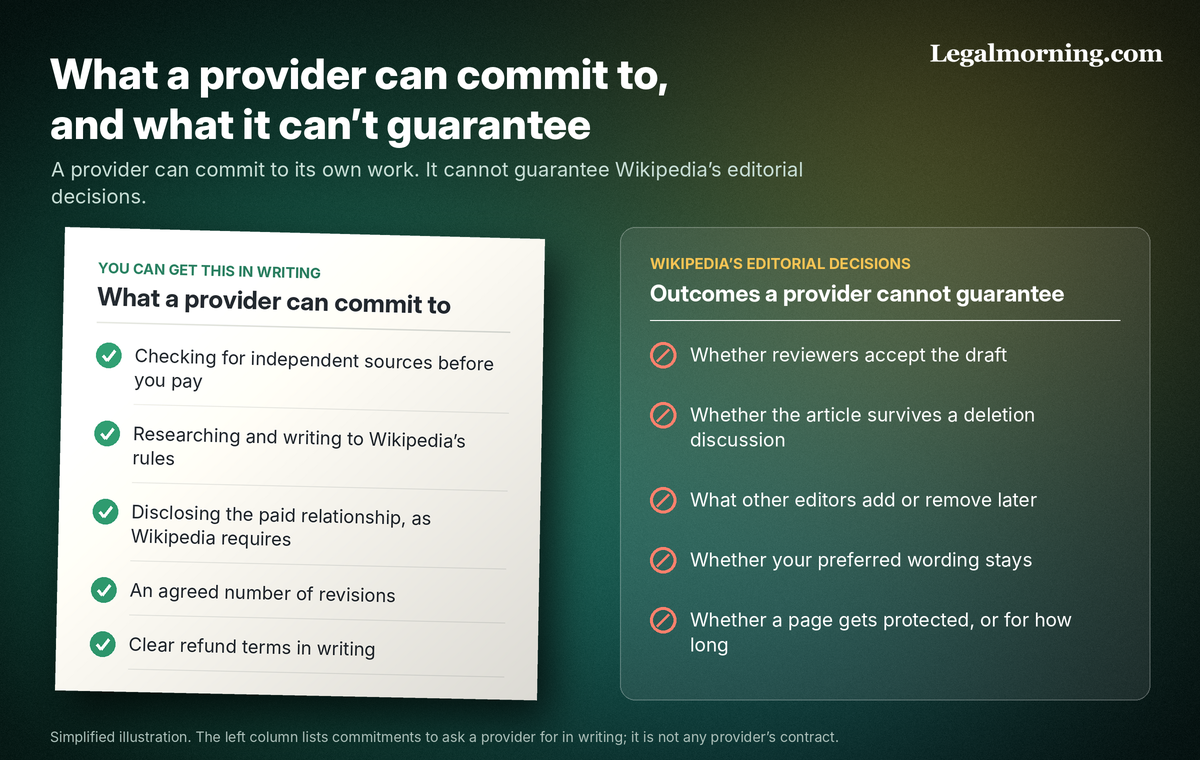
What a Wikipedia provider can commit to in writing, and the outcomes it cannot guarantee.
What has to go right for a Wikipedia page
Creating a page involves more than getting it published. The sources, writing, review, and later editing all affect whether it stays.
- Eligibility. Wikipedia’s notability guideline asks whether reliable, independent sources have covered the subject in depth. That is the first thing I check.
- Article quality. A notable subject can still get a poorly written article. Promotional writing, weak sourcing, or unsupported claims can draw warning tags, cuts, or a deletion nomination.
- Review. Wikipedia’s conflict of interest guideline directs paid editors to submit new articles through draft review. Reviewers are told to accept a draft if it would probably survive a deletion discussion. Acceptance does not guarantee it will.
- Later editing. Other editors can change a published article, subject to any page protection. They may add information you would rather leave out.
- Possible deletion. Any editor can nominate an existing article for deletion, even years after it was accepted.
Meeting notability doesn’t guarantee a Wikipedia page
Significant coverage in independent sources means a subject is “presumed” to merit an article. The guideline says that is “an assumption, not a guarantee.”
Editors can still decide a topic belongs inside a broader article instead of on its own page. Or they can decide a subject doesn’t belong in an encyclopedia at all.
Consensus decides, and it isn’t a vote
Wikipedia runs on consensus. The quality of an argument and its basis in policy matter more than the number of people supporting it.
A deletion discussion usually lasts at least seven days. Editors recommend an outcome, and the person closing it weighs their arguments against Wikipedia’s policies.
A small group cannot use a local discussion to override a broader Wikipedia policy.
Who participates still matters. Editors decide which sources to raise and argue about how the policies apply.
I compare it to court: both sides can know the law and disagree about how it applies. Wikipedia editors can disagree about whether sources and wording meet the rules. You may not get the outcome you hoped for.
Three deletion discussions with different outcomes
These public discussions concern people who are not my clients. I never use clients as examples.
Jay Baer: deleted in 2017
Jay Baer is a marketing author and keynote speaker. In June 2017, an editor nominated his Wikipedia article for deletion, calling him a blogger and writing, “1000 of such bloggers are there who just write a blog column in popular media channels.”
One editor argued to delete, calling the article promotional and Baer an insignificant marketing executive and author. Another argued to keep, pointing to his three books and his media appearances.
The sources offered to back up that keep argument were Baer’s own books and the press page of his speaking business. An editor answered: “three out of four sources above are to the subject himself, while the fourth is to his speaker bureau. Not independent coverage by any means.”
The discussion was relisted twice to draw more participants. The final comment before the close called Baer a “shilly shill” and accused him of “using a charity illegally to spread his name.” That comment offered no evidence for the accusation.
The article was deleted on July 18, 2017. As of November 2026, Wikipedia has no article on Jay Baer.
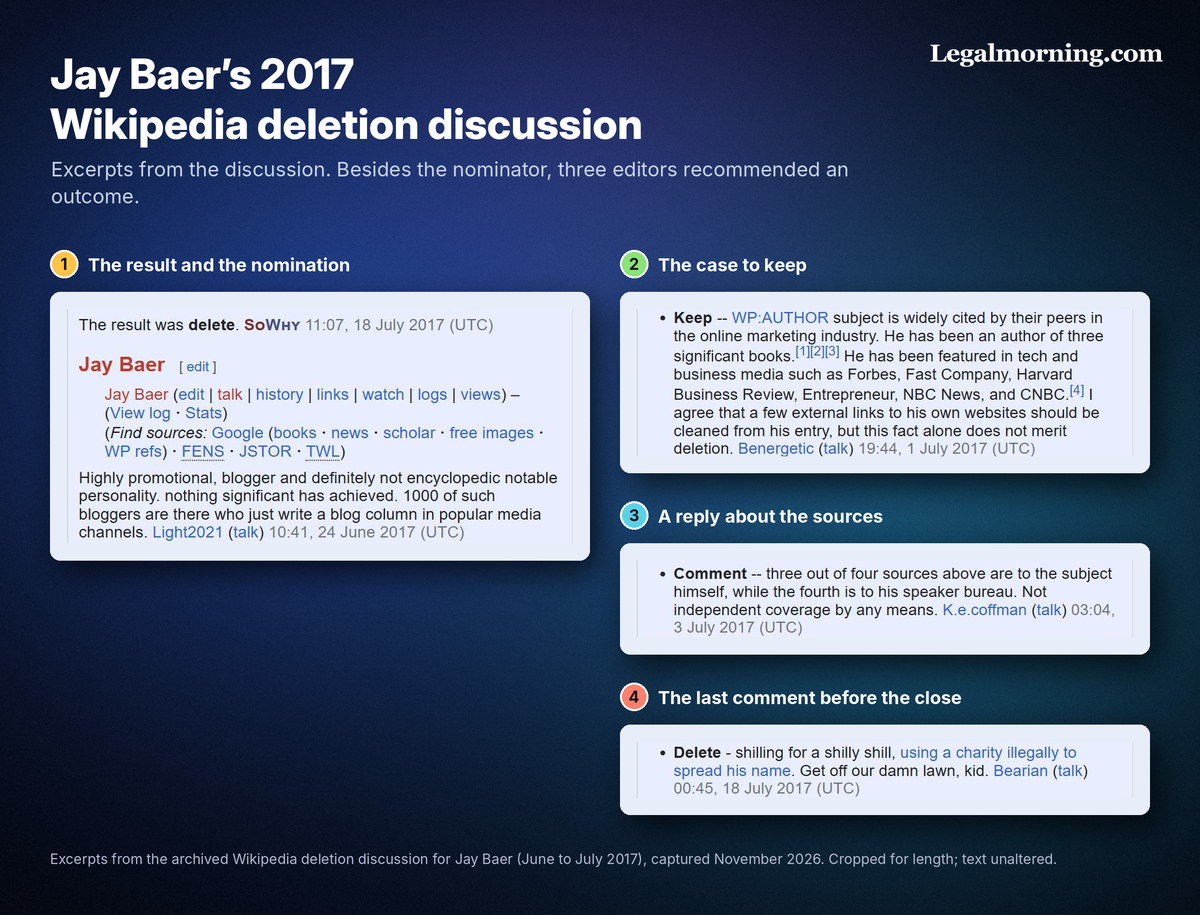
Excerpts from the 2017 deletion discussion for Jay Baer’s Wikipedia article. Besides the nominator, three editors recommended an outcome.
My take: I don’t think the people in that discussion knew who Baer was in the marketing world.
On Wikipedia, recognition within an industry does not replace coverage in independent sources.
BigDawsTv: deleted in 2017, a new article in 2021
BigDawsTv is a YouTube prank channel run by Dawson Gurley. In April 2017, an editor nominated its article for deletion, calling it “An unremarkable YouTube channel.”
Several YouTube articles faced deletion discussions that spring. One participant wrote that they were “already planning to review every ‘Youtube celebrity’ in an AfD this month.” AfD means Articles for deletion.
Editors who wanted to keep it pointed to coverage in People magazine, local TV stations, and Tubefilter, a site that covers online video. Editors who wanted to delete it called that coverage local or tabloid-like.
The article was deleted on May 16, 2017. The closing statement read: “Broad consensus here that the sources, even when in otherwise reliable publications, do not cover the subject in sufficient depth.”
In March 2021, a new article on Dawson Gurley was created. In September 2024, it was nominated for deletion. This time, an editor pointed to coverage in the Washington Post, SFGate, and Bleacher Report, including a 2022 Washington Post story that didn’t exist in 2017. The discussion closed with no consensus, and the article stayed.
In December 2025, the article was renamed BigDaws. It is live as of November 2026.
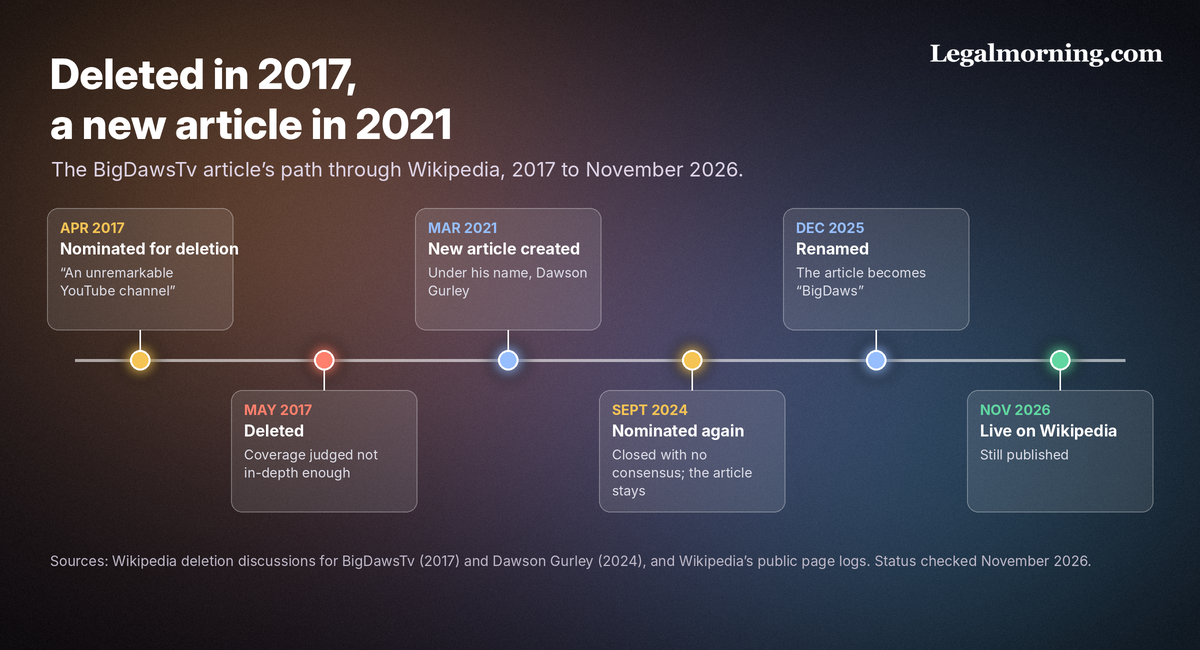
The BigDawsTv article’s path through Wikipedia from 2017 to November 2026. Dates come from the deletion discussions and Wikipedia’s public logs.
Danny Sullivan: challenged twice, kept twice
Danny Sullivan is a longtime search industry journalist who co-founded Search Engine Land in 2006.
His Wikipedia article first went to a deletion discussion in 2008. Editors pointed to coverage of Sullivan in USA Today and the New York Times, and it was kept within days.
In April 2015, an editor tagged the article as possibly not notable. Two months later, Sullivan complained about the tag. Another editor removed it and wrote on the article’s talk page that the question should be settled: “Either he’s notable or he isn’t.”
The same day, the editor who had added the tag opened a second deletion discussion. Several editors argued that news stories only quoted Sullivan and never covered him in depth.
On July 3, 2015, Matt Cutts, then a Distinguished Engineer at Google, weighed in. He said Google took Sullivan’s coverage seriously. He also wrote, “it sounds like Wikipedia prefers published material,” and pointed to the USA Today and New York Times profiles and a book chapter about Sullivan.
Another editor answered that they would “disregard the anecdotal evidence” and stick to Wikipedia’s rules.
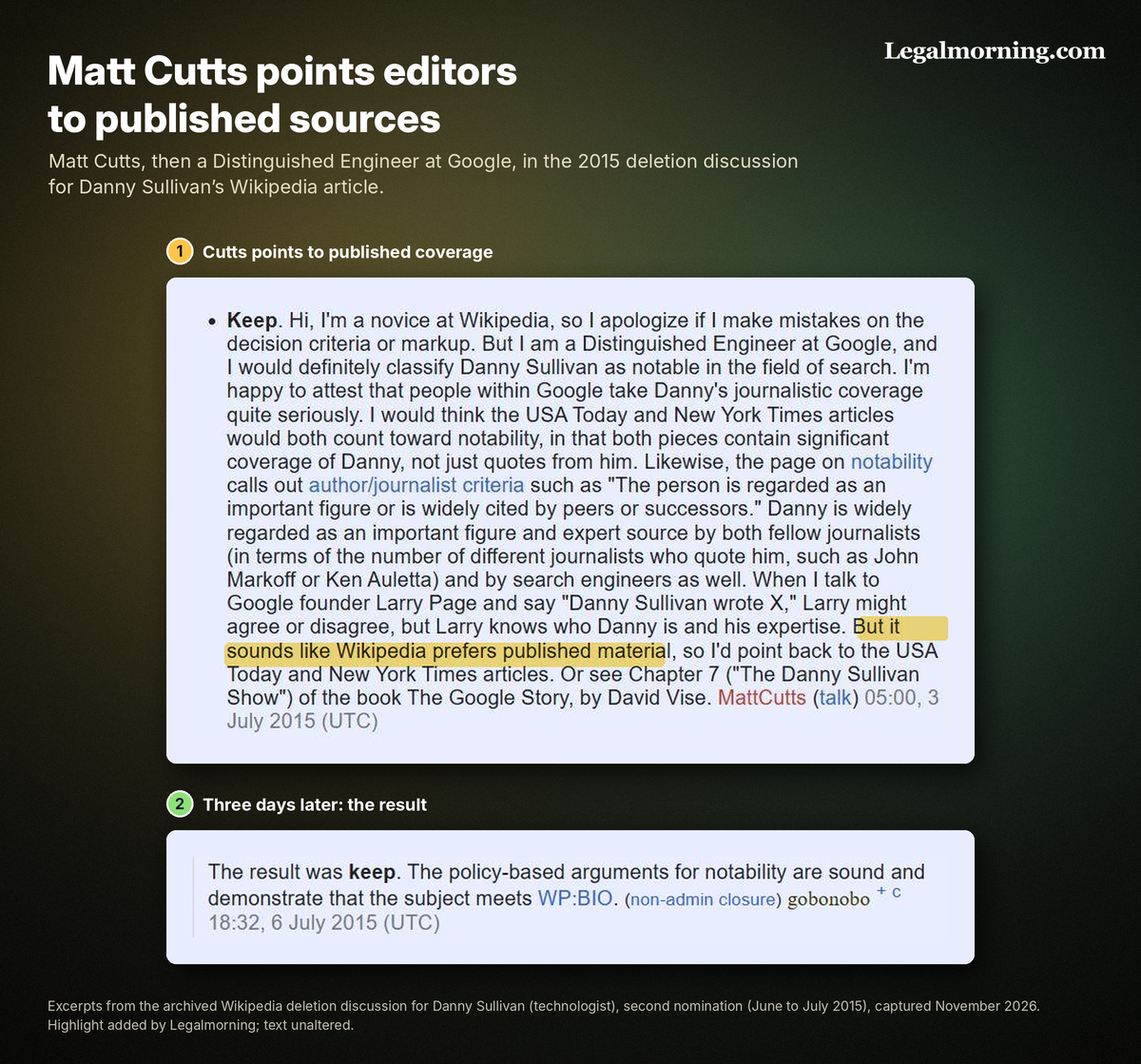
Matt Cutts’s comment in the 2015 deletion discussion for Danny Sullivan’s Wikipedia article, and the closing result.
The discussion closed as keep on July 6, 2015. The closing statement said the “policy-based arguments for notability are sound.” The article is live as of November 2026.
The record doesn’t show how much Cutts’s participation influenced other editors. I wrote about this discussion on LinkedIn at the time.
Wikipedia isn’t your website
Your website is yours. You decide what it says.
Wikipedia doesn’t work that way. Its ownership policy says even the subject of an article doesn’t own it or have “any right to dictate what the article may or may not say.”
Wikipedia’s conflict of interest guideline strongly discourages you and anyone working for you from editing your article directly. It asks you to propose changes on the article’s talk page instead.
Paid editors must disclose who is paying them, including their employer, client, and affiliation. The Wikimedia Foundation, the nonprofit that operates Wikipedia, requires this disclosure.
Even Wikipedia’s co-founder couldn’t control his own page
In December 2005, Jimmy Wales edited his own Wikipedia biography, changing “co-founder” to “founder.” Within two days, another editor had changed the wording again.
His edits drew news coverage, and Wales apologized after a blogger publicized them.
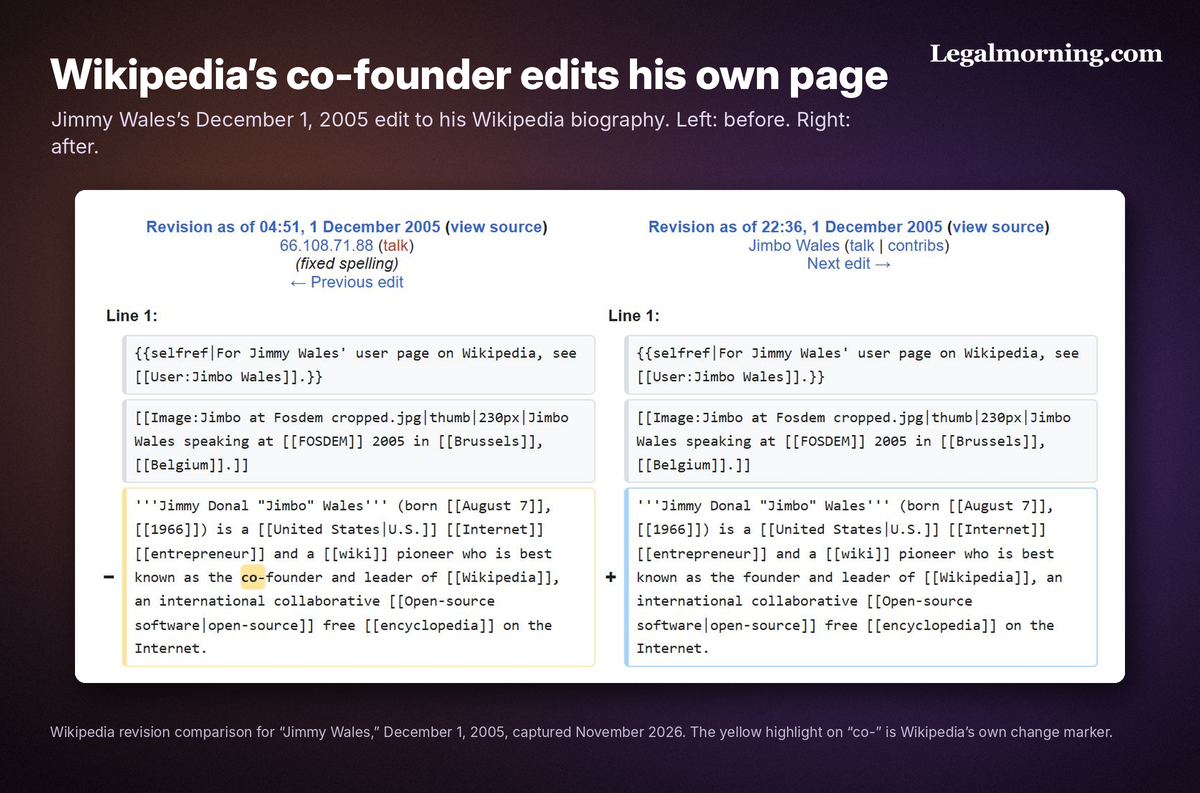
Jimmy Wales’s December 1, 2005 edit to his own Wikipedia biography. The highlighted text shows “co-founder” changed to “founder.”
A Wikipedia page is a risky reputation tool
This is also why I never recommend using Wikipedia to manage your reputation.
You can create a page with positive information. You can’t stop other editors from adding the negative. If it’s well sourced and within the rules, it can go in.
Page protection does not give you control
Clients have asked me to create a page and then “lock” it so only they can control it. That is not what page protection does.
Administrators apply the usual forms of article protection under Wikipedia’s protection policy. Anyone can request protection, but it needs a reason, such as persistent vandalism or an edit war.
Here are the main levels:
| Protection level | Who can still edit |
|---|---|
| Pending changes | Anyone, but edits from new or unregistered users are reviewed before most readers see them |
| Semi-protection | Only established registered accounts |
| Extended confirmed protection | Only accounts with a longer editing history |
| Full protection | Administrators only |
Protection can last for a set period or indefinitely. Wikipedia generally doesn’t protect a page just in case something goes wrong.
What protection doesn’t do:
- It doesn’t make anyone the owner of the page.
- It doesn’t endorse the current wording. The policy tells administrators to avoid favoring one version over another.
- It doesn’t freeze the content. Anyone can propose a change on the article’s talk page with an edit request, and it can be made when it’s uncontroversial or has consensus.
Why some providers promise to guarantee a Wikipedia page
A refund policy is different from a promise of guaranteed approval.
A provider can offer a refund if a draft is declined. That promise concerns its own money, not control over Wikipedia. A money-back offer alone is not evidence of a scam.
Promises of “guaranteed approval,” a “permanent page,” or control over the wording are another matter. No provider can guarantee those outcomes.
In my experience, some providers offer guarantees because they treat Wikipedia like blog writing or backlinks. They do not understand the review process. That can leave you with:
- A deleted page because no one checked whether the subject qualified.
- A declined draft because the sources were too weak.
- Warning tags because the article did not follow Wikipedia’s writing and sourcing rules.
I’ve also seen providers submit dozens of drafts without checking whether the subjects qualify. Clients risk paying for a declined draft or a page that is later deleted. Those submissions also create work for volunteer reviewers.
Questions to ask before you hire anyone
A good provider can answer these plainly, in writing:
- What will you deliver: a draft, a published article, or edit requests on an existing page?
- Will you check whether I qualify before I pay? Which sources will you assess?
- How many rounds of revisions are included?
- What happens if the draft is declined? Are revisions and resubmissions included, and how many?
- What are the exact refund conditions?
- Will you disclose the paid relationship on Wikipedia, as the rules require?
- What follow-up is included, such as monitoring the page or requesting corrections?
If the answer to any of these is “don’t worry, it’s guaranteed,” keep looking.
Summary
A provider can commit to research, writing, revisions, disclosure, and clear service terms. No provider can guarantee a Wikipedia page, its permanence, or control over later edits.
Unsure whether a Wikipedia page or edit is realistic? Request a free project evaluation. I’ll review the available sources and any previous attempts, then explain what may be possible before you commit.