A Wikipedia error can become its own source when a reporter repeats it and a Wikipedia editor cites the story as evidence. That cycle is referred to as the Wikipedia feedback loop.
I’ve worked with clients who have found the same mistake in their Wikipedia article and in news coverage. An AI answer can also spread that mistake to anyone who asks about you.
Dealing with an error right now?
Go straight to the steps to track down and fix the origin of the error.
How the Wikipedia Feedback Loop Works
A reporter researching for a story finds and takes a detail from Wikipedia. Later, a Wikipedia editor finds the published story and adds it as a source on a specific Wikipedia page. The source now sits in Wikipedia, acting like an independent source that verifies the information.
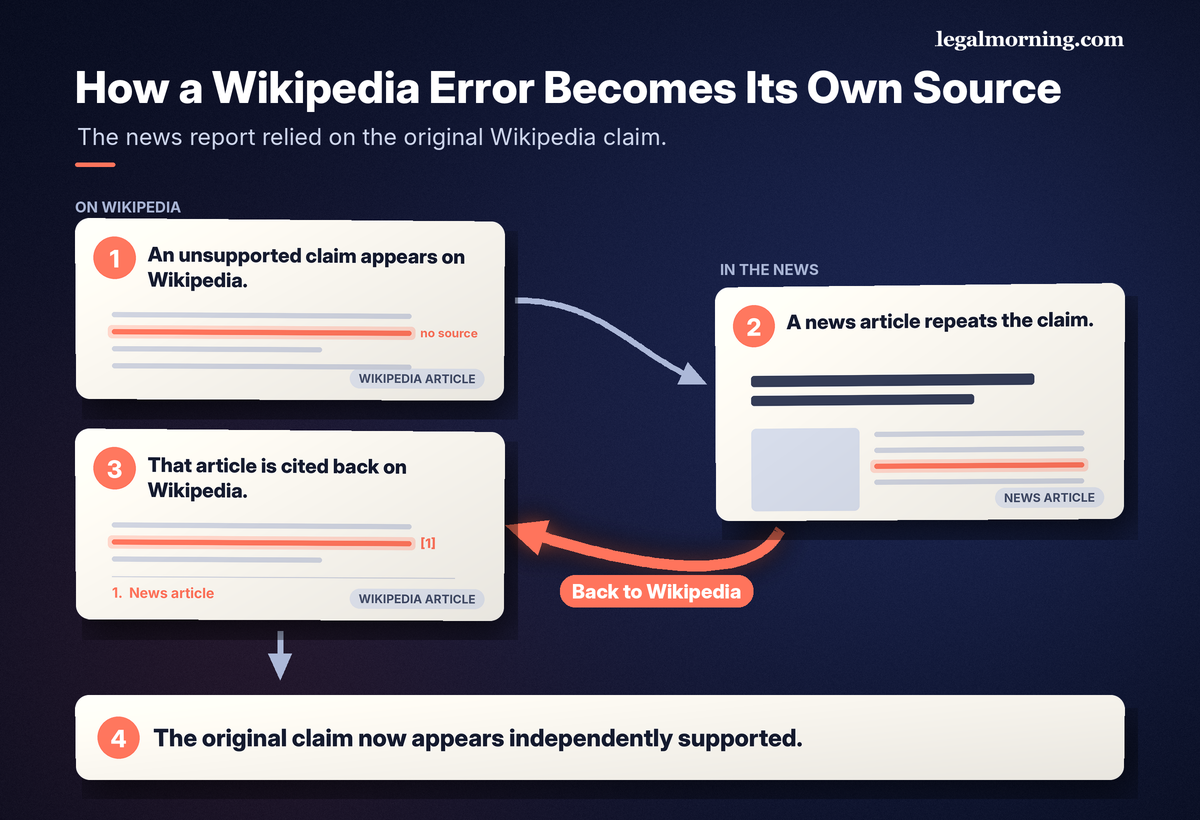
This is called circular reporting, sometimes referred to as circular sourcing or citogenesis. Wikipedia keeps a list of citogenesis incidents it has dealt with in the past.
When Wikipedia Errors Become News
The toaster inventor who never existed
In February 2012, an editor changed Wikipedia’s article on the toaster to credit the invention to an Edinburgh inventor named Alan MacMasters. He labeled the edit as reverting vandalism.
There was just one problem.
Alan MacMasters was his friend.
The following year, he went a step further and created a full Wikipedia biography for this made-up inventor, using a doctored photo of himself as the portrait.
From there, the claim took on a life of its own. The BBC reported that the Daily Mirror included the toaster on a list of British inventions, more than a dozen books repeated it, and it even showed up on a Scottish government website.
By July 2022, an archived version of the biography was citing articles from major news outlets as sources. In other words, the coverage the hoax created was now being used to prove the hoax was true. The hoaxer later told the BBC that his claims “would get picked up in different types of media, I would cite them, and they would become fact.”
It finally unraveled in 2022 when someone noticed the altered photo. Editors questioned the sources and deleted the biography a few days later, and the BBC eventually traced the hoax back to its creator.
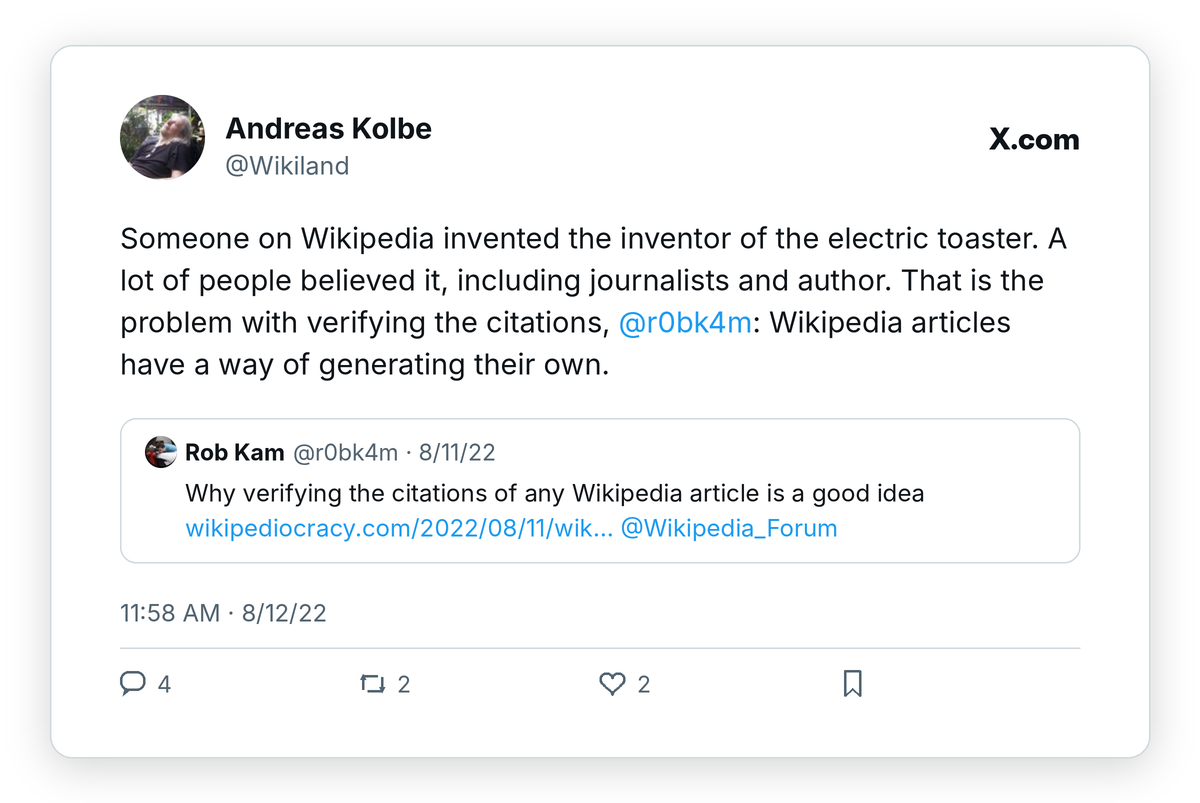
Andreas Kolbe summed it up on X, saying Wikipedia articles “have a way of generating their own” citations.
An extra name in a German minister’s biography
In 2009, German politician Karl-Theodor zu Guttenberg already had a long list of given names. An editor decided to add one more, “Wilhelm,” to his German Wikipedia biography.
Within hours, dozens of news outlets were using the extra name, as The Irish Times reported.
Here’s where it gets interesting.
On Wikipedia, an editor removed “Wilhelm” and said a specific source was needed, but the name was restored the same afternoon. Less than an hour later, the same editor who had asked for a source added a Spiegel Online article as the source for the full list of names. That article included “Wilhelm.”
The edit history shows who added the Spiegel citation, but nobody knows for sure where Spiegel got “Wilhelm” in the first place. Editors removed the name again once the prankster explained what he had done.
Jonathan Crossfield had warned about this a few months earlier, writing in 2008 that news reports built on Wikipedia can end up validating the very entries that caused the error.
A composer’s obituary quoted words he never said
In March 2009, shortly after composer Maurice Jarre died, an editor added a made-up quote to his Wikipedia biography. Editors removed it twice, but the third time it stayed up for about a day. That was long enough for obituary writers to find it. The Guardian opened and closed its obituary with the quote, and several other obituaries repeated it.
Nobody caught the mistake until the editor who added it emailed the publishers nearly a month later. The Guardian later explained what went wrong: the quote had no footnote, and the paper never credited where it came from.
Wikipedia does have a rule against this. Editors aren’t allowed to cite a publication for information that publication took from Wikipedia. The problem is that it’s hard to spot when the footnote just names a newspaper. Even after editors remove an error, a copy can survive in a news story that another editor finds years later.
How AI Can Spread the Same Error
AI tools can pick up a Wikipedia error in two ways:
- Training data: English Wikipedia is one of the sources used to train large language models.
- Web search: AI tools like ChatGPT can search the web and cite pages when they answer a question, and Google says its AI Overviews draw on web results.
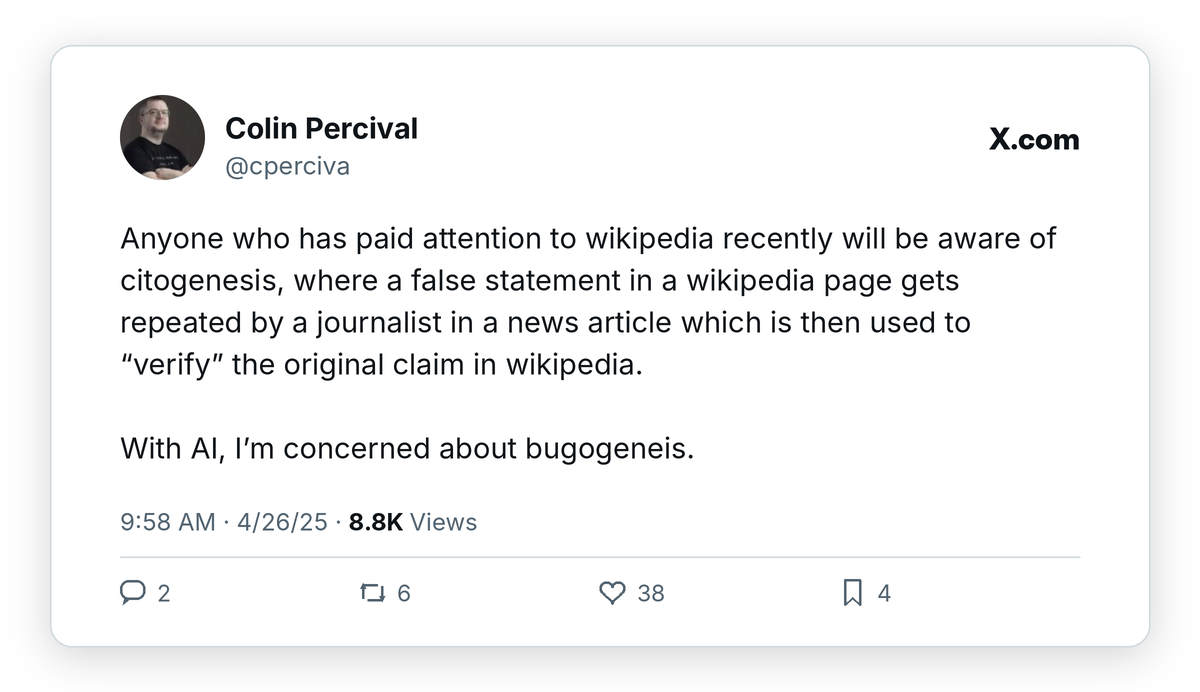
That raises an obvious question, and Colin Percival asked it on X: could AI give a Wikipedia mistake a brand new route back into the article?
AI can misstate a correct source
Even when the source is right, AI can still get the details wrong. The BBC tested this by asking four popular AI assistants, including ChatGPT and Gemini, 100 news questions. Its study, published in February 2025, found factual errors in 19% of the answers that cited BBC content.
So, if an AI answer cites a source, open it and check the detail yourself. Don’t be surprised if the answer doesn’t match what the source says.
When AI joins the Wikipedia feedback loop
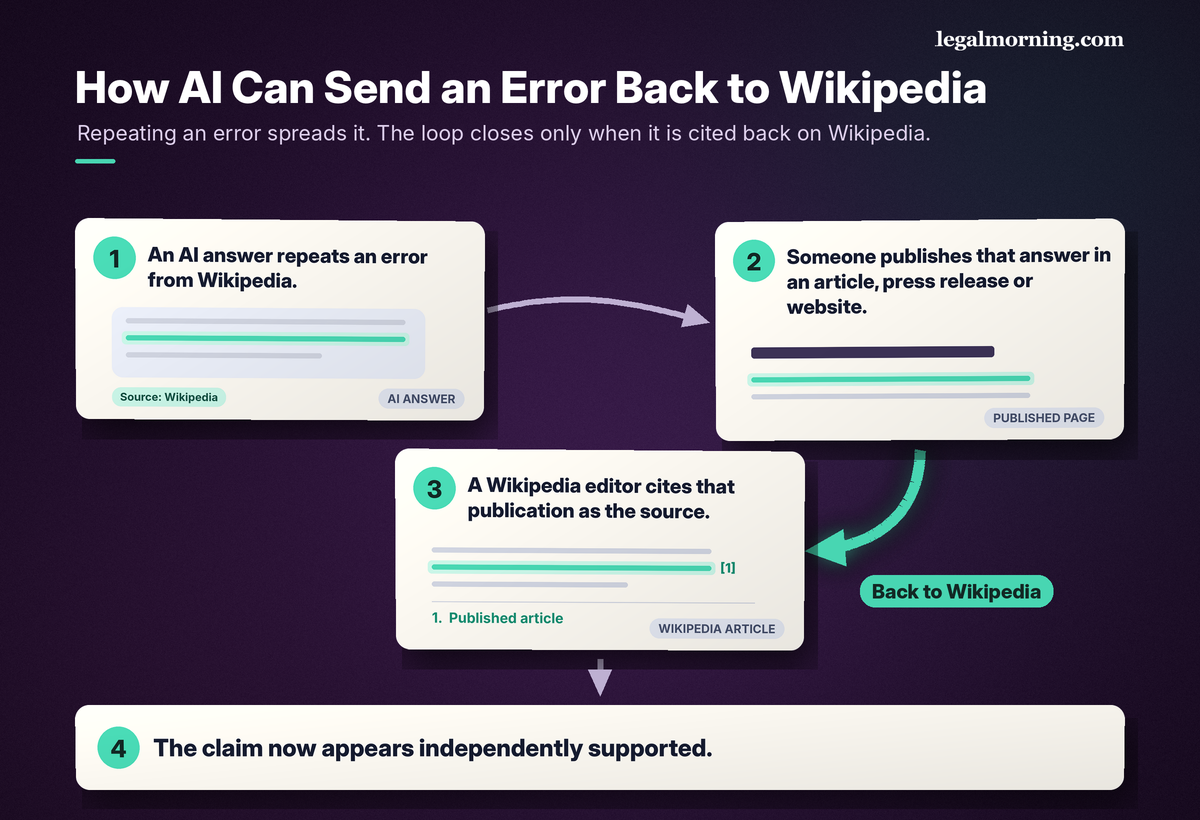
For an AI answer to complete the loop, two things have to happen.
- Someone has to publish the mistaken claim.
- A Wikipedia editor has to cite that publication for the same claim.
Here’s how that plays out:
Wikipedia does have a little protection here. English Wikipedia considers AI-generated text generally unreliable as a source, and prohibits using AI chatbots to write or rewrite articles.
Wikipedia Isn’t Your Newsroom
Wikipedia’s no original research policy requires editors to base articles on published sources. That means Wikipedia isn’t the place to set the record straight with your own account of what happened. You have to fix the source first.
If a reporter misquoted you, take the recording to the newsroom and ask for a correction. Once the correction is published, a Wikipedia editor can cite it. If the newspaper quoted you correctly but Wikipedia changed the meaning, show the editor the published wording.
There are also several things Wikipedia editors can do on their end. They can:
- remove a claim the cited source doesn’t actually support
- remove poorly sourced contentious claims about living people
- reject a source shown to have copied Wikipedia
- present conflicting reliable sources instead of picking one
- require stronger sourcing for surprising claims
I can’t stress this enough: it is NOT Wikipedia’s responsibility to correct an error it is reporting on. Your first step is to contact a reputation management firm to get the original news reporting corrected.
How to Trace Where the Error Started
Before anything else, if a living person’s biography contains harmful, poorly sourced material, flag it right away. Wikipedia’s contact page for article subjects points readers to the Biographies of Living Persons Noticeboard for this.
Otherwise, your goal is to figure out where the mistake started and build a record of how it spread.
Collect the evidence
- Search for the exact claim. Use the specific wording. In Guttenberg’s case, the giveaway was “Wilhelm” sitting among his other given names.
- Save every place it appears. Record the URL, the date you saw it and a screenshot.
- Save AI answers in full. Keep the question you asked, the full answer and any sources it shows.
- Check the citations. Open the source Wikipedia cites for the claim, along with any links shown in the AI answer, and note whether each one actually says what it’s being cited for.
Work out where it started
- Find the Wikipedia revision. Use the article’s “View history” tab to find the first version that contains the claim. Save that version’s permanent link, or the “diff” link that shows exactly what changed.
- Compare dates. A Wikipedia edit dated before a news story shows which came first, but it doesn’t prove the reporter used Wikipedia. You can use the Internet Archive’s Wayback Machine to see what a page said on a past date.
- Look for evidence of copying. Matching wording or the same unusual mistake is a good lead, but both could have come from an earlier shared source. Stronger evidence is a reporter saying Wikipedia was the source, a published correction explaining the mistake, or a story that credits Wikipedia directly.
- Build a short timeline. List the dates, links and evidence in order, then add reliable proof of the correct fact, such as an official record or independent reporting.
Don’t wait until you’ve found every copy before asking for a correction. Start with the article Wikipedia cites and the pages linked in the AI answers people are actually seeing.
How to Correct a Wikipedia Feedback Loop
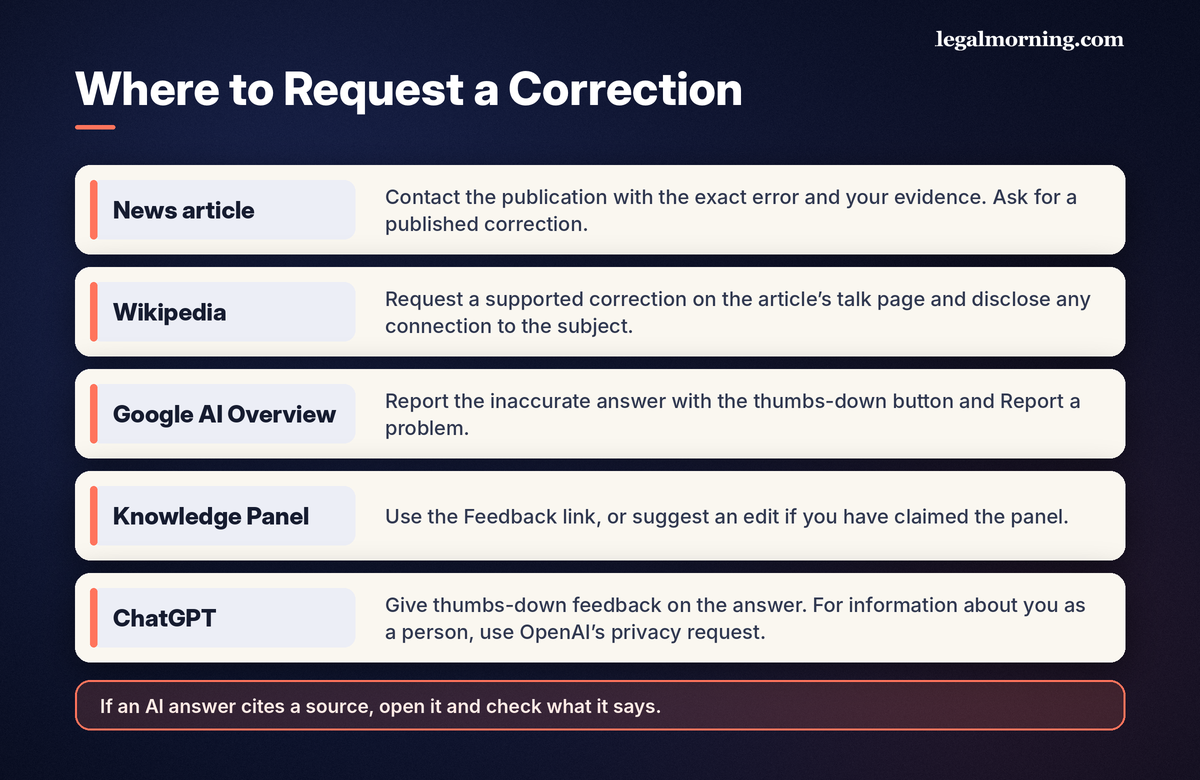
Ask the publication for a correction
Send the exact error and your evidence to the publication’s corrections desk or the reporter who wrote the story.
If you think the story relied on Wikipedia but can’t prove it, just ask. Something like: “An earlier version of the Wikipedia article contains the same wording. Can you tell me what source you used for that statement?”
Here’s a simple template you can use:
Subject: Correction request: [article headline], [publication date]
Your article “[headline]” ([URL]) states that “[exact sentence].” This is incorrect. [Correct fact.] Supporting evidence: [records or independent reporting, with links]. Please publish a correction or update the article with a correction note. Thank you for reviewing this.
[Your name, your connection to the subject, contact information]
Save whatever reply you get. If other outlets republished the story, check whether their copies picked up the correction too.
Bring the evidence to Wikipedia
Once you have a published correction or evidence of copying, take it to Wikipedia editors. A reporter acknowledging the mistake carries a lot more weight than two publication dates.
If Wikipedia misquotes an accurate source, put the two passages side by side so editors can see the difference. If the claim isn’t supported at all, point to the exact sentence you want removed.
Follow Wikipedia’s conflict-of-interest rules
If the article is about you, your company or a client, you have a conflict of interest. That means you should disclose your connection and propose the change on the article’s talk page so another editor can review it. Wikipedia discourages editing directly when you have a conflict, although even the subject of an article can fix a very obvious error in their own biography.
If you’re paid or expect to be paid for a contribution, the Wikimedia Foundation’s Terms of Use require you to disclose who is paying you.
A good talk-page request names the exact sentence, says what should change, links to the reliable source and briefly explains any circular-sourcing problem. My Guide to Disclosing a Wikipedia Conflict of Interest and Requesting Edits walks through disclosure and the request format step by step.
If someone reverts your edit, read their edit summary or the talk-page discussion before you respond.
Keep in mind that accurate reporting can still be unflattering. The Guide to Removing Negative Information from a Wikipedia Biography explains when you can challenge that kind of information.
Correcting an Error in Google or ChatGPT
Start by opening the cited page and finding the passage the answer relies on. If that page contains the error, ask its publisher to correct it. If the answer misreads an accurate page, report the answer itself. If there’s no source at all, save the answer and search for its exact wording to find where it came from.
How you fix it depends on where the error shows up:
- In an ordinary search result: Google says it mainly uses a page’s own content for the short description under a link, so the fix starts with that page.
- In a Knowledge Panel: This is the information box about a person, company or thing. Google builds panels automatically from sources across the web. If you’re the subject or an official representative, you can claim the panel and suggest edits. Anyone else can use the feedback link at the bottom right of the panel.
- In an AI Overview: This is the AI-written summary at the top of some searches. At the bottom of the overview, select the thumbs-down icon, then Report a problem, and choose the category that fits. Add details in the text box.
If the page has been corrected but Google still shows the old snippet, the site owner can request a recrawl in Search Console. If it’s not your page, use Google’s Refresh Outdated Content tool once the page has been removed or substantially changed. You’ll need to sign in, so have a word or two from the old snippet ready.
ChatGPT and other large language models
Click the thumbs-down button beneath the inaccurate answer and include the disputed wording, along with a source if you have one.
If the answer contains inaccurate personal information about you, you can also request removal of personal data from ChatGPT responses through OpenAI’s Privacy Portal. Select “Make a Privacy Request,” then “Remove personal data from ChatGPT responses.” You’ll need to identify the answer and verify your identity, and OpenAI reviews each request individually.
Over the following weeks, repeat your original search and save the answers so you can see whether anything has changed.
Note that most large language models have similar reporting features to ChatGPT. Use them to report any misinformation that may surface.
Make the Correct Facts Easy to Find
The best defense is making sure the correct information is easy for reporters, editors and AI tools to find:
- Keep your official biography, About page, company history and media page accurate and current.
- Make sure key facts, like founding dates, leadership and locations, match across your own sites.
- Review your profiles on sites like LinkedIn and Crunchbase for old or wrong details.
- Keep documents that support facts people get wrong, such as filings, records or earlier reporting.
Just keep in mind that this helps reporters more than it helps Wikipedia. A reporter can check a detail against your official bio, but a Wikipedia editor needs independent sources. Five profiles copied from your bio still only give an editor your word for it.
Breaking the Wikipedia Feedback Loop
Fixing a feedback loop starts with the footnote next to the error. If the newspaper got it wrong, ask for a correction. If Wikipedia misread the story, show editors the passage. Once the source is right, go back and check the copies and AI answers that are still carrying the mistake.
If you’re dealing with a Wikipedia sourcing or correction problem, reach out for a free evaluation. We can help you figure out where the error started and help get things corrected.