Wikipedia allows paid editing, but it has strict guidelines on disclosure. Anyone who is paid to edit must disclose such, including who pays them and the beneficiary of the edits. You are also expected to request edits on the talk pages of existing articles, and submit new pages through the articles for creation process.
Despite strong guidelines on paid editing, the rules have not always been that way.
It took more than two decades of scandals, failed proposals and public fights to get there. In fact, I was part of one myself (more on that later).
Let me walk you through the rules and how they have evolved over the last two decades. It’s important to know the disclosure requirements, and what happens if you ignore them.
Timeline at a Glance
First, a quick timeline for quick reference.
- ●2001
Wikipedia launches and requires neutral articles from the start, with no rule written just for paid editors. - ●2006
MyWikiBiz writes Wikipedia entries for businesses for under $100. Its account is blocked within days. - ●2007
Microsoft draws criticism for offering to pay a blogger to edit technical articles. - ●2007 to 2013
Editors propose a paid editing rule four times. None passes. - ●2011
PR firm Bell Pottinger is reported to have made hundreds of edits to its clients’ articles. - ●2012
Jimmy Wales calls for a “bright line” against paid editors editing articles directly. - ●2012
The Gibraltarpedia controversy pushes a Wikimedia UK board member to step down. - ●2013
The Wiki-PR scandal leads to more than 250 blocked or banned accounts and a cease and desist letter. - ●January 2014
A Wikimedia Foundation employee leaves after accepting payment to create articles. - ●June 2014
The Terms of Use make paid editing disclosure mandatory. - ●2015
The Orangemoody case ends with 381 accounts blocked and 210 articles deleted. - ●2018
Paid editors must link their user pages to their outside advertising accounts. - ●2023
The Terms of Use add the “intended beneficiary” and require account disclosure in ads. - ●2024
Wikipedia’s community newspaper estimates more than 95% of companies selling Wikipedia pages are scams.
No Paid Editing Rules
For its first 13 years of existence, Wikipedia had no specific rules for paid editors. All editors, paid or not, were bound by the same editing guidelines and policies agreed upon by consensus of the community.
You would think those rules would be fine. After all, articles were required to be neutral in tone, free from advertorial language, and to include references that were not self-promotional.
The issue is that people tested the limits. In fact, paid editors were notorious for violating all of those rules, especially those related to promotional tone.
Outside of the dozens of paid editors violating the rules, there were several incidents that brought paid editing to light in the early years.
The first was MyWikiBiz, a Wikipedia editing service created by Gregory Kohs in 2006. MyWikiBiz would author Wikipedia entries for businesses for under $100 and Kohs’ account was quickly blocked within days of Wikipedia editors being notified. When asked about the business, Kohs told the Associated Press that Wikipedia co-founder Jimmy Wales called the business “antithetical” to Wikipedia’s mission.
In January 2007, Microsoft took heat for offering to pay a blogger to fix what it saw as errors in technical Wikipedia articles. The media picked up the story, and it quickly spread throughout the Wikipedia community.
Editors tried to get ahead of the game by introducing paid editing guidelines in 2007 and 2009. Both proposals failed.
In 2011, Wikipedia was hit with another paid editing scandal. PR firm Bell Pottinger was caught making hundreds of changes to Wikipedia articles for its clients. The problem? Editing client Wikipedia pages was still not restricted per se.
Editors again introduced guidelines for paid editors in 2011 and 2013. Both of those proposals failed as well.
Jimmy Wales Draws a “Bright Line”
As Wikipedia’s co-founder, Wales was often the person volunteer editors looked to for advice on paid editing. Wikipedia had always had a negative opinion of the industry, but in 2012 Wales took a formal stance in what he called the “bright-line rule” regarding paid advocacy on Wikipedia.
In an interview with The Signpost, Wales stated what was the foundation of modern-day paid editing policy:
“You should disclose your conflict of interest and never edit article space directly.”
Jimmy Wales, co-founder of Wikipedia, October 2012
That was Wales’s personal position, not an official guideline. Still, Wikipedia editors began enforcing it as if it were.
The Gibraltarpedia Controversy
Wikipedia had its own conflict of interest issue in 2012, affecting its own leadership. A member of the Wikimedia UK board stepped down after it was discovered he was working as a paid consultant for Gibraltar. He was doing so while leading the Wikipedia project on the subject.
Wales called the arrangement “wildly inappropriate for a board member of a chapter.” The incident caused the Wikimedia Foundation to order an outside review of how Wikimedia UK handled conflicts of interest within the chapter.
The following year is what started the big push for established guidelines on paid editing. Let me introduce you to Wiki-PR.
The Wiki-PR Scandal
In October 2013, Wikipedia editors uncovered what was at the time the largest sockpuppet network in the site’s history. A firm called Wiki-PR had been caught using multiple accounts to edit Wikipedia pages for clients. They advertised having a staff of 45 Wikipedia editors and administrators and over 12,000 clients. Clients reported paying $500 to $1,000 per page with an additional monthly fee for monitoring.
And yes, there is a connection between myself and Wiki-PR. More about that later.
Investigators confirmed 323 sockpuppet accounts and suspected dozens more. More than 250 of those accounts were blocked or banned and Wiki-PR was banned from the site.
In November that year, the Wikimedia Foundation sent a cease and desist letter to Wiki-PR, a move that furthered the Foundation’s stance against paid editing.
Unfortunately for the Wikimedia Foundation, it was hit with its own scandal a few months later. An employee for the Foundation left after it was discovered she had accepted payment to create Wikipedia pages.
Wiki-PR effectively became the fuel for creation of paid editing guidelines, while the incident with the WMF employee became the match.
In 2014, Disclosure Became Mandatory
In February 2014, the Foundation proposed changing its Terms of Use to ban undisclosed paid editing and opened it up for public comment.
Why Terms of Use?
Well, several proposals for paid editing guidelines had failed to gain consensus of the Wikipedia community. A change to the Terms of Use did not need community consensus.
The Wikimedia Foundation board of directors approved the change in April 2014 and it became effective that June. For the first time, anyone paid to edit had to disclose who they worked for, either on their user page, on the article’s talk page or in an edit summary.
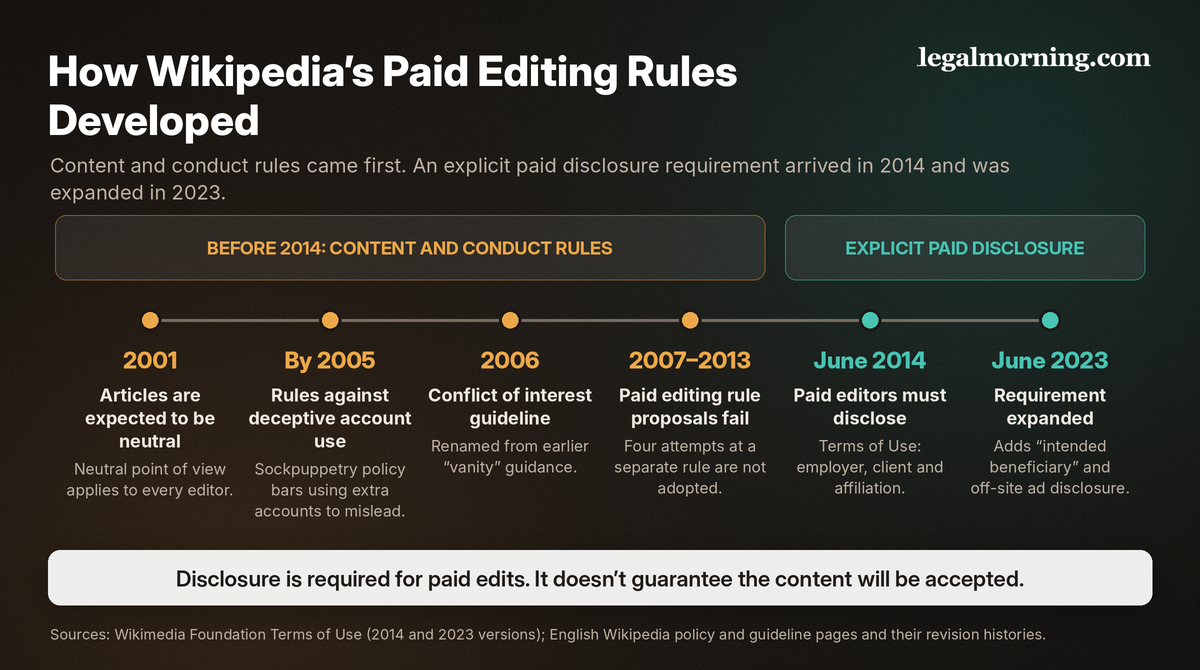
The rules that applied before 2014, and what the 2014 and 2023 changes added.
From 2015 to 2020, Enforcement Picked Up
The floodgates opened up after the change in terms of use. English Wikipedia adopted a paid editing policy that incorporated the Foundation’s new disclosure rules.
Editors who hated paid editing now had the backing of a policy to enforce it if undisclosed.
And paid editors? Well, most didn’t seem to care. They would soon learn though.
In 2015, editors broke up a paid editing ring known as Orangemoody. They blocked 381 accounts and deleted 210 articles that were created by the operation. The incident brought something to light that most editors never considered…scams.
Orangemoody would extort clients. The outfit would accept payment to create a Wikipedia page, then tell clients they had to pay to keep them from being deleted. They would then delete articles for those who refused to pay.
More and more paid editing firms were caught editing without disclosure and added to the list of paid editing companies and banned from the site.
In January 2018, a rule covering every Wikimedia project passed. Paid editors had to disclose their outside accounts where they advertised their work, including Upwork and Fiverr.
English Wikipedia also began outlining processes for paid editors to follow, including how to request edits on the talk page. A “Connected contributor” notice was created to flag paid involvement in articles and paid editors were told to use the articles for creation process.
In 2023, the Rules Got More Strict
In June 2023, the Foundation updated its Terms of Use with more requirements. Paid editors began having to disclose any “intended beneficiary” of their work. The Foundation also added an offsite disclosure, requiring any advertisement for services to include the Wikipedia accounts a paid editor used to perform the services.
While paid editing is allowed and many people adhere to the rules, the problem of undisclosed paid editing has not gone away.
In January 2024, The Wikipedia Signpost estimated that more than 95% of companies selling Wikipedia pages are scams, and that fewer than 5% of their customers ever get an article. The Foundation’s lawyer said the 2023 update let it step up enforcement, and that it would keep putting resources into it.
What Paid Editors Are Currently Required to Do
Anyone paid to edit Wikipedia has to disclose four things:
Disclosure can be made in one of three places (I advise clients to do all three):
- ✓User page of the editor.
- ✓Talk page of the article where edits are requested.
- ✓In an edit summary.
The rules cover employees too. If you’re paid to handle publicity and you edit Wikipedia about your employer, you’re a paid editor, even if Wikipedia isn’t in your job description.
Wikipedia also strongly discourages paid editors from editing articles directly. The rules allow it, but you are asking for trouble. Propose changes on the talk page with an edit request so volunteer editors can review. New pages should be submitted through the articles for creation process.
There is a minor exception to the rules I want to point out.
Anyone with a conflict of interest is allowed to make uncontroversial edits such as fixing a typo, repairing a broken link, or removing obvious vandalism or spam. Most volunteers will not push back on these. I still recommend requesting the edit on the talk page unless it is something defamatory that should be removed immediately.
These rules apply to English Wikipedia. Other language Wikipedia projects have adopted their own paid editing guidelines in accordance with the Wikimedia Foundation’s terms of use.
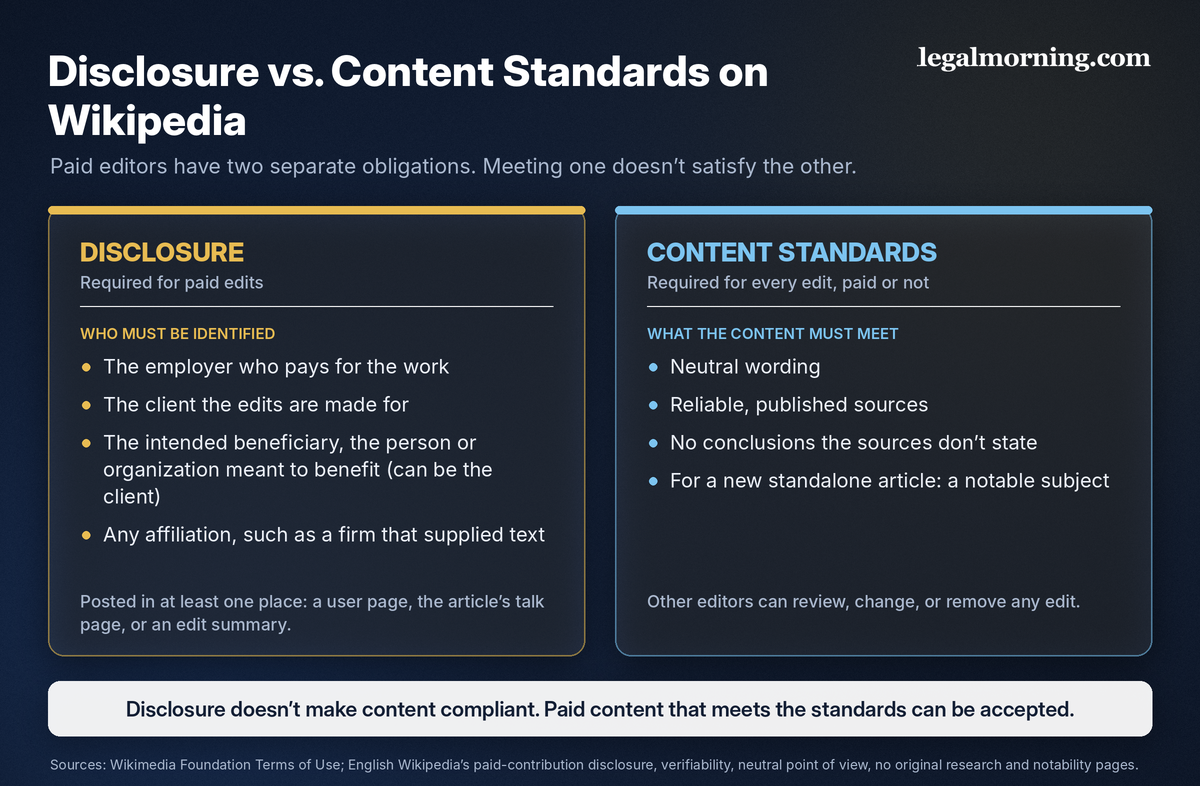
What paid contributors have to disclose, and the content standards their work still has to meet.
What Happens If You Don’t Disclose
Paid editors who fail to disclose can have their accounts blocked and banned from editing. While I have seen some editors receive a second chance and have their ban lifted, I do NOT recommend editing without disclosure. It can be a painstaking process to get unbanned and there is never a guarantee.
If you are using sockpuppet accounts to edit while not disclosing, your client can suffer as well. Wikipedia allows articles created by these accounts to be deleted without discussion.
Articles can also be tagged with an ugly paid editing banner at the top. Kind of a badge of shame for the client.
Undisclosed paid editing doesn’t benefit anyone.
Where I Fit Into This History
I started editing Wikipedia in 2008 under the account Morning277. Around 2012 I answered an ad on a freelance website for someone looking for a Wikipedia editor. Since I had experience and understood the page creation process, I took the job.
To keep my main account from being noticed as a paid editor, I used an alternate account. Took another job…used another account.
It caught up to me in August 2012. Here is the “more on that later” part. I had been contracted by Wiki-PR to do some editing. I used multiple accounts and my main account to do so. Those accounts were connected and Morning277 was blocked.
I responded like many paid editors did at that time. I just created more accounts and kept editing. That lasted until 2013 when the community reached a consensus to ban me from the site.
When the Wiki-PR story broke, a lot of the coverage called Morning277 a Wiki-PR account. It wasn’t. I took subcontracted work from Wiki-PR as a freelancer, but Morning277 was my own account, not theirs. Even Wiki-PR confirmed it. But the mark stuck, and it’s one of the reasons I tell people to disclose so they don’t wind up in the same situation.
Thankfully, the media investigated and determined I was not Wiki-PR, something that was later confirmed by Wikipedia editors. Clients sometimes hired more than one provider, so my account and accounts from other paid editing companies often wound up editing the same pages.
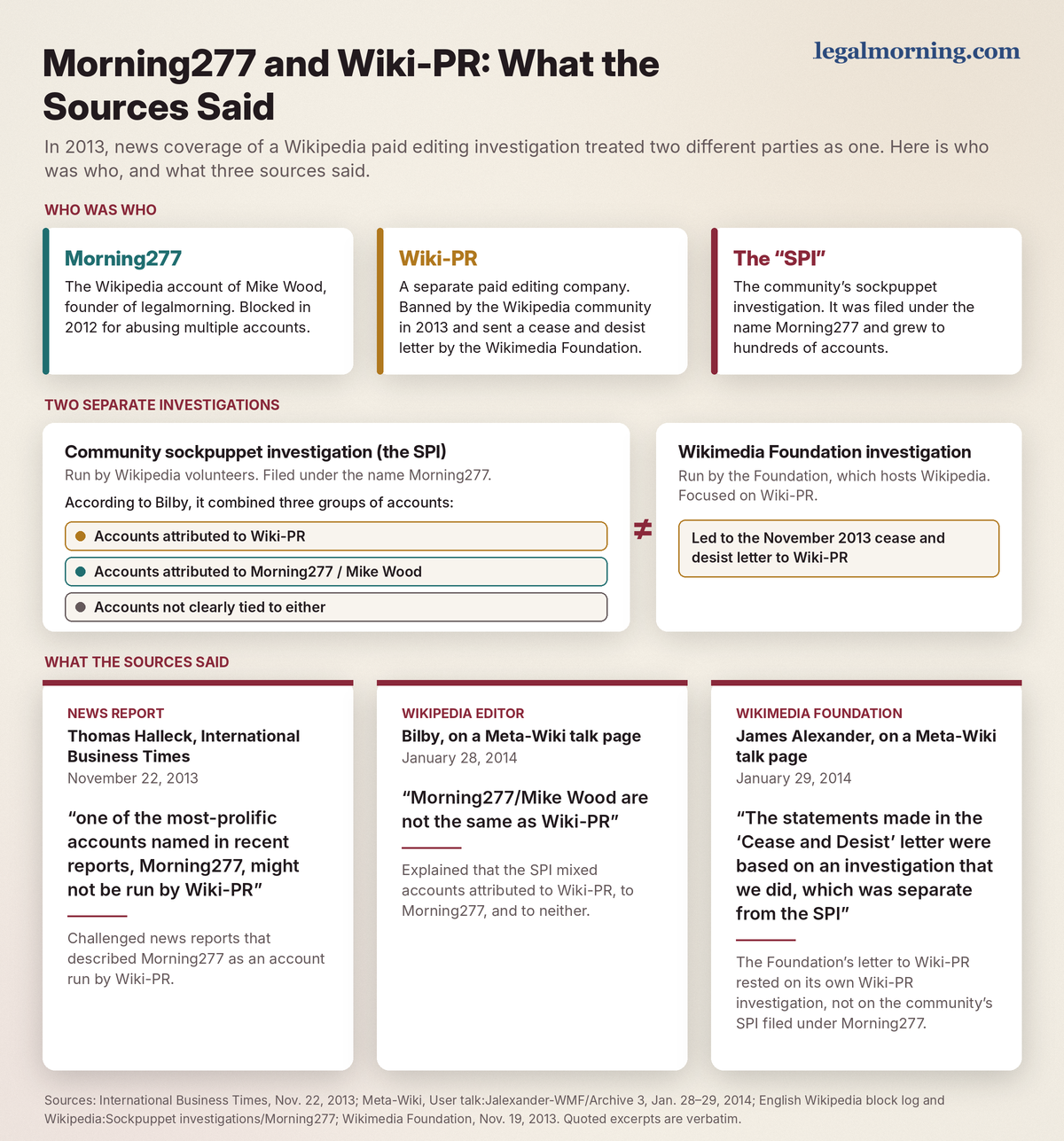
Morning277 and Wiki-PR: what the sources said.
I appealed my ban in August 2025. Despite the explanation I provided, the community declined to lift the ban.
So, how do I operate despite the ban?
Today, I mainly consult but also assist in reviewing and writing drafts when necessary. I also review projects for notability and advise if a topic would likely meet those requirements.
As part of the consulting, I instruct clients on how to disclose their conflict and how to request changes without editing directly. And no, I do not edit Wikipedia directly. One reason for requesting the lift of the ban is that I cannot control client disclosure since I am not allowed to edit directly. I advise on disclosure, but cannot control what is actually disclosed.
Final Thoughts
Paid editing is allowed, as long as you disclose it and follow the process. Your content must still be written according to guidelines and being a paid editor does not allow you to control content that goes on Wikipedia.
Thinking about a Wikipedia project? Reach out for a free evaluation. I’ll be happy to walk you through your options.